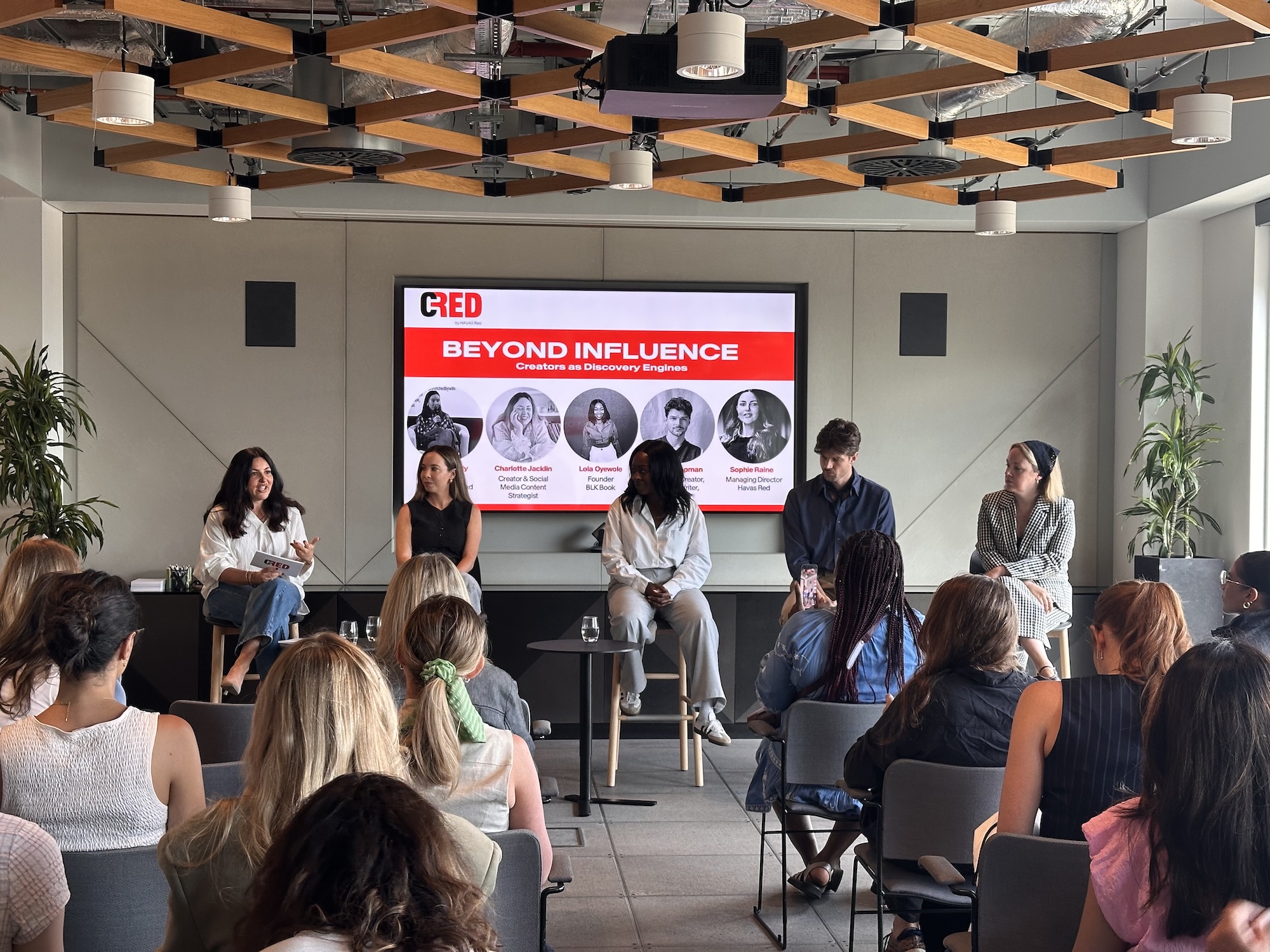
“Beyond Influence: Creators as Discovery Engines,” a panel hosted by HAVAS Red London’s Managing Director Sophie Raine, brought together a mix of perspectives from across the creator economy, where one core challenge was put to brands: innovate or become irrelevant.
Georgia Kelly, Head of Creator Partnerships at Snap, Charlotte Jacklin, creator and social strategist, Jim Chapman, creator and author, and Lola Oyewole, founder of creator agency BLK Book, alongside Raine, explored how many of today’s creator strategies are increasingly removed from how people actually discover, engage and behave.
“We still tend to talk about creators as if they’re a channel that’s growing in importance, something to scale, optimize and plug into a broader plan,” said Raine. “When in reality, that approach is dated and doesn’t match how audiences are discovering, engaging and amplifying.”
A few years ago, discovery had a clearer starting point, with audiences actively engaging in defined moments, often manufactured by brands. Now, it’s far more ambient, always-on and most importantly, more human.
“There could be hundreds of people talking about something, but who is the right person to go to and tell that story?” said Oyewole, challenging scale as the default measure of success and instead reinforcing the value of relevance, credibility and context.
There’s still an instinct for marketers to go broader and bigger when it comes to creators but, as feeds become more saturated, audiences are far more selective about what they engage with and, crucially, who they believe. “It’s not enough for something to be seen; it has to feel like it belongs, and that’s where a lot of brand content still falls short,” Oyewole added.
Charlotte Jacklin’s point that “you’re not making an advert” highlights a persistent gap. Too often, brands still approach creators as a channel to deliver messaging instead of seeing them as partners, and curators of their own communities.
Georgia Kelly built on this, noting that success often comes when it’s “not about selling, but about entertaining,” underlining the role platforms like Snap play in the daily lives of Brits, who snap more than 55 times a day.
If discovery is happening through a series of interactions across different creators, platforms and communities, it becomes harder to rely on one-off bursts of activity to drive any kind of lasting impact.
As Jim Chapman put it, “It chips away at your integrity if it’s one-and-done. I’d rather show and not sell to my audience,” reflecting something audiences have become highly attuned to. Trust is built gradually, through consistency and repetition. Anything else risks feeling transactional.
“What works more effectively is a shift toward ongoing presence and more considered partnerships that build familiarity over time, rather than chasing immediate visibility,” said Raine.
This is where the industry is starting to recalibrate. Moving away from short-term creator activations towards something much more sustained, where creators are genuine brand fans and credibility is built collaboratively with the communities they influence, rather than delivered top-down by brands.
This ethos sits at the heart of CRed, HAVAS Red’s evolved creator and influence practice designed to help brands earn lasting cultural credibility in a creator-powered world. Not by amplifying messages, but by embedding brands more meaningfully within the conversations, communities and cultural moments that shape discovery in the first place.
The challenge brands face isn’t about creator ecosystem best practice, but whether they are willing to rethink where credibility is actually built and what role they need to play within it.